
Missing Conversations About Reproductive Health
Understanding Fertility & Birth Control.

I was sixteen when my doctor first suggested I take hormonal birth control. At the time, I was dealing with acne and the self esteem challenges that often come with it. When birth control was presented as a way to improve my skin, I was open to trying it. Like many young people (and adults) appearance can feel important, and the insecurity I felt about my skin played a significant role in my decision.
During that first gynecologic visit, a Pap smear was recommended simply because I was already there, even though I was not sexually active. I remember the experience as being physically uncomfortable. After the exam, I was prescribed Ortho Tri Cyclen Lo to address my acne, with pregnancy prevention mentioned as an additional benefit should I become sexually active in the future.
I stayed on the pill for about six years. While it didn’t resolve my acne, I continued taking it because I was genuinely afraid of becoming pregnant. Growing up, I carried a deep fear of unintended pregnancy. My high school sex education focused almost entirely on the dangers of pregnancy, often in ways that felt alarmist, without teaching how to understand or live in relationship with our hormonal cycles. At the same time, teen pregnancy was a frequent storyline on popular television shows, which only reinforced the idea that pregnancy could quickly upend a young woman’s life. Subconsciously, I believed that if I wasn’t on the pill, I would somehow be irresponsible and at risk.
I didn’t question this decision until my early twenties. A close friend shared that her mother, a nurse, had advised her not to take hormonal contraception. Instead, she learned how to monitor her basal body temperature, cervical mucus, and other fertility indicators, which my friend tracked carefully in a journal. I was struck by how her mother’s medical background challenged my assumption that hormonal birth control was the default or automatically the best option for women our age. That conversation opened my eyes to possible alternatives I hadn’t considered.
Looking back, I realize that I was not given the tools or comprehensive education needed to make an informed decision about whether the pill was truly the right choice for me. With more practical information that considered my personal health, lifestyle, and values, I may have made a different choice. This experience highlights a broader point: true informed choice depends on access to high quality education and supportive resources that many women simply do not have.
My story is far from unique. I recently spoke with an OB/GYN whom I deeply admire, and she reminded me of the gaps in women’s health research limit what clinicians can confidently recommend. That reality underscores a simple truth that women deserve better.
Historically, women have been excluded from medical research because their hormonal cycles were perceived as complicating study results. In animal studies, the uterus is even removed to avoid hormonal fluctuations. The reality is that there is still so much we do not fully understand about the female body. While federal research policy in the U.S. (if there is funding) now requires inclusion of female biology, this policy is only about a decade old, meaning many studies lack robust female representation; a factor that affects everything from drug dosing to understanding disease.
I recently read a New York Times article1 on natural family planning. Natural Family Planning (NFP) is a type of Fertility Awareness Method (FAM), which refers to strategies that track signs of fertility like cervical mucus, basal body temperature, and cycle patterns to either avoid or achieve pregnancy. All NFP methods are FAMs, but not all FAMs are considered NFP. Unlike some broader FAM approaches, NFP sometimes emphasizes abstinence on fertile days, though the underlying tracking methods are the same.
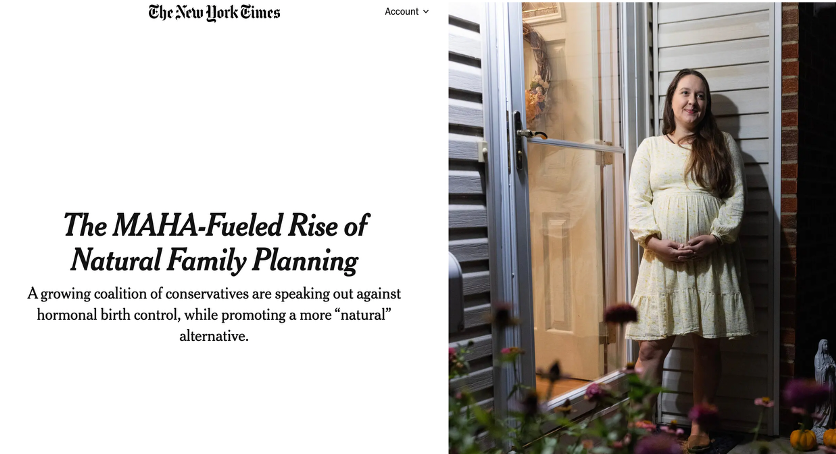
The piece does not differentiate between the various fertility awareness methods and describes them as highly unreliable, framing their use primarily within religious or conservative communities. I found this framing concerning because it risks “othering” people who choose non-hormonal or non medical device based approaches, implying that their choices are unintelligent or misguided. From a public health perspective, it is important to provide balanced, nonjudgmental information, recognizing that different methods may be appropriate for different individuals depending on their needs, preferences, and circumstances.
There are several aspects of this article that raise questions for me. In particular, it made me realize just how common discussions of reproductive health are often framed using political labels such as “conservative” or “liberal.” While these terms might be intended to provide context, they obscure the underlying health issues and contribute to unnecessary division, especially around the female body.
The article opens by profiling a woman who teaches natural family planning methods via video calls to couples who wish to avoid pregnancy without using hormonal contraception. While the piece briefly notes the couples’ motivations, the emphasis appears to be more on identity rather than on the broader reasons individuals may seek different approaches to fertility management. A more expansive framing could help readers better understand the diverse needs, values, and circumstances that shape reproductive health decisions.
In observing cultural conversations around fertility management, I’ve noticed that fertility awareness methods are often discussed primarily in the context of avoiding pregnancy. This might help explain why they are sometimes more readily accepted within certain religious or cultural communities. At the same time, throughout history, many families have used fertility awareness to support conception.
Regardless of the reason someone chooses to use these methods, it raises a broader and, I think, reasonable question: what is the harm in ensuring that women (and men) have a basic understanding of the menstrual cycle and the hormonal processes involved in conception and pregnancy? Increasing foundational knowledge can support informed decision making, respect personal values, and complement, rather than replace, other forms of reproductive care.
There is a challenging reality in reproductive health education: Parents find it difficult to have conversations with their kids, and schools provide limited instruction. As a result, young people have unanswered questions and turn to Tiktok, online forums and chatbots instead of engaging in thoughtful dialogue with a trusted adult. I’ve observed that many young women and men are not given a clear understanding of how the menstrual cycle works. This can make sexual health feel taboo, leaving them to navigate it largely on their own. When that happens, there can be real consequences, including unintended pregnancy and sexually transmitted infections, many of which are not prevented by the pill, hormonal IUDs, implants, or shots (like Depo-Provera).
I’ve also noticed that conversations about reproductive health can quickly become polarized, even when people are simply asking thoughtful questions, for example, about the safety of certain forms of birth control. Recent research has uncovered real safety concerns associated with the Depo Provera shot2, illustrating why it’s important to discuss
